Zakat Calculator Pakistan 2026 | Calculate Online Free
Estimate annual Zakat at 2.5% on cash, gold, silver, investments, and business assets after debts, with a customisable nisab threshold.
Zakat is one of the five pillars of Islam, and for many households in Pakistan the practical question each year is simple: how much do I actually owe? This free Zakat calculator helps you estimate your annual obligation by adding up cash, gold, silver, investments, business inventory, and other zakatable assets, subtracting debts that are due, checking whether your net wealth meets the nisab threshold, and applying the standard 2.5% rate.
Because gold and silver prices move every day, the rupee value of nisab changes too. The tool lets you enter today’s nisab in PKR so your estimate stays current for Ramadan 2026, the Islamic new year, or whichever lunar anniversary you use for your Zakat year. All math runs in your browser — your asset figures are not uploaded to a server.
This guide explains what counts as zakatable wealth in everyday Pakistani practice, how nisab works under the gold and silver standards, walks through realistic PKR examples, and answers the questions people ask most often before they give. Treat the result as a clear planning figure, then confirm edge cases with a qualified scholar or your local mosque if your situation is complex.
On this page
What this Zakat calculator does
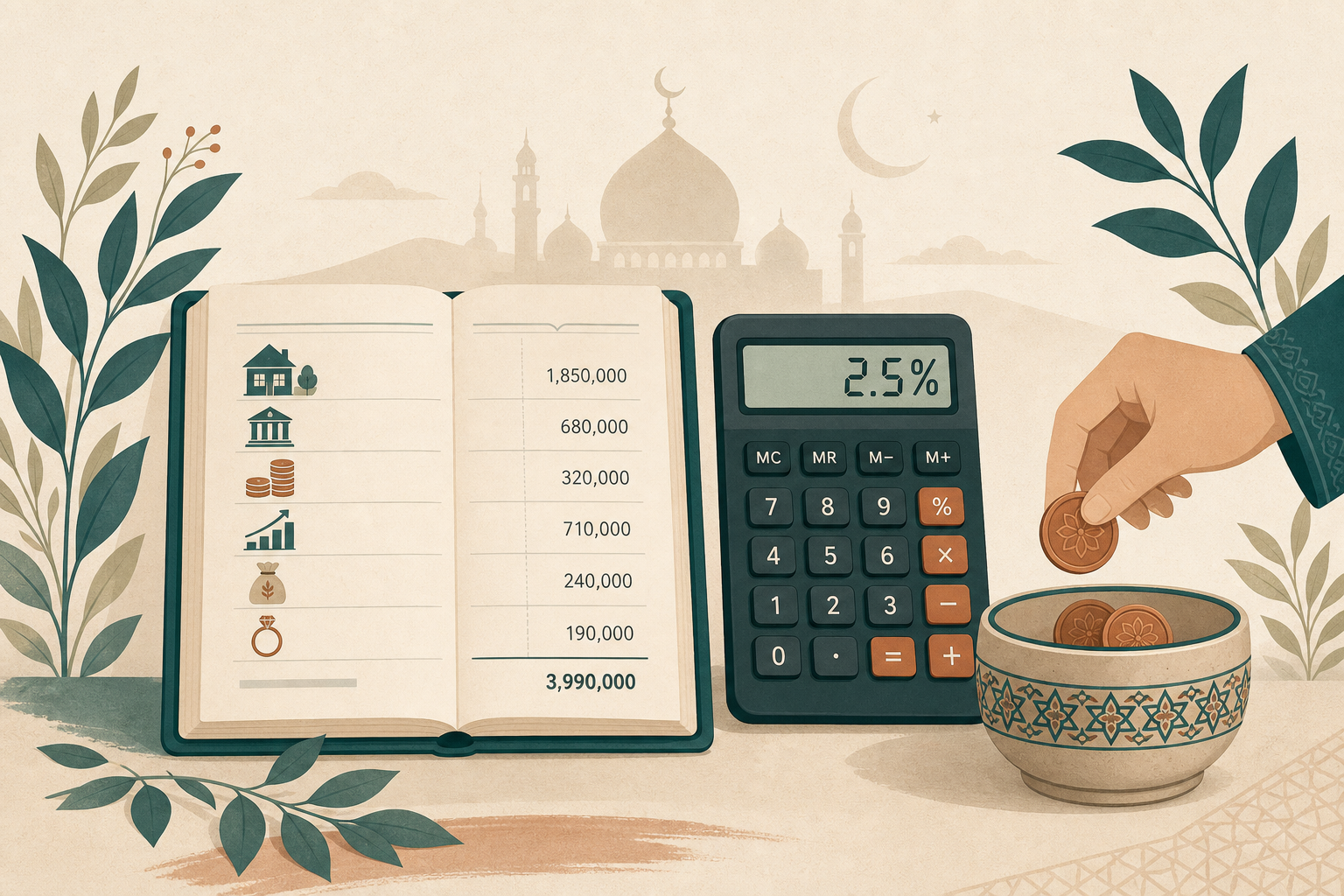
A Zakat calculator turns a list of assets and liabilities into a single obligation figure. You enter the market value of wealth you own and control, subtract short-term debts, compare the remainder with your chosen nisab, and — if you meet or exceed nisab — multiply that zakatable wealth by 2.5% (one-fortieth).
People in Pakistan use a tool like this before Ramadan, when banks deduct Zakat from eligible accounts on 1st Ramadan for some savers, and whenever a full lunar year (hawl) has passed on savings that already sat above nisab. It is also useful if you hold gold jewellery, mutual funds, or shop inventory and want a transparent total before you write a charity cheque or transfer to a trusted organisation.
How Zakat works: rate, hawl, and ownership
For cash and most tradeable wealth, the widely taught rate is 2.5% per lunar year. That percentage applies to the net zakatable amount at the end of your Zakat year, not separately to every deposit you made during the year. If wealth stays above nisab for a full hawl, Zakat becomes due on the total that remains (after allowed deductions) at the calculation date.
Ownership and control matter. Money you hold for someone else, assets you do not truly own, or property held purely for personal use (such as your primary home and everyday household goods) are generally treated differently from surplus cash, investment portfolios, and goods held for sale. When in doubt about a specific asset class — for example crypto, provident fund balances, or rented property — note the value separately and ask a scholar rather than guessing inside the calculator.
Zakat is an act of worship with precise rules in classical fiqh. Online tools, including this one, apply the common numerical framework used for planning; they do not replace personalised religious guidance.
Nisab threshold: gold vs silver in PKR

Nisab is the minimum level of wealth that makes Zakat obligatory. Classical measures are roughly 87.48 grams of gold or 612.36 grams of silver. Because you pay Zakat in money, you convert those weights into today’s PKR market price for gold or silver, then use that rupee figure as your threshold.
Many scholars and charities in South Asia discuss both standards. The silver nisab is usually lower in rupee terms, so more people meet it; the gold nisab is higher. Your school of thought, local mosque guidance, or preferred charity may recommend one approach. This calculator does not lock you into either — you type the PKR nisab you intend to follow after checking current bullion prices.
Update the nisab field whenever gold or silver prices move materially, especially in the weeks before Ramadan when many Pakistanis settle their Zakat. A stale nisab from last year can understate or overstate whether you are liable at all.
Which assets to include (and what to leave out)
Typically included at current market value: cash at home and in bank accounts, gold and silver (including jewellery for many opinions, valued at melt or market value as your scholar advises), shares and mutual fund holdings, business stock and inventory held for sale, and receivables you reasonably expect to collect.
Often excluded or treated carefully: your primary residence, furniture and personal effects used daily, tools of a trade in some views, and long-term debts structured differently from bills due soon. Debts that are immediately payable are commonly subtracted from assets before testing nisab; long mortgage schedules may be handled under more specific rules — again, ask if unsure.
If your bank will auto-deduct Zakat from a savings account in Ramadan, still run this calculator on your full picture. Bank deduction usually covers only eligible account balances under the bank’s policy, not gold in a locker, stock in a shop, or investments held elsewhere.
- Cash, current and savings balances in PKR (and foreign currency converted to PKR)
- Gold and silver at today’s market value
- Stocks, funds, and similar investments you own
- Business inventory and goods purchased for resale
- Collectible debts owed to you (if recovery is likely)
- Minus: debts and liabilities you must pay soon
How to use this calculator step by step
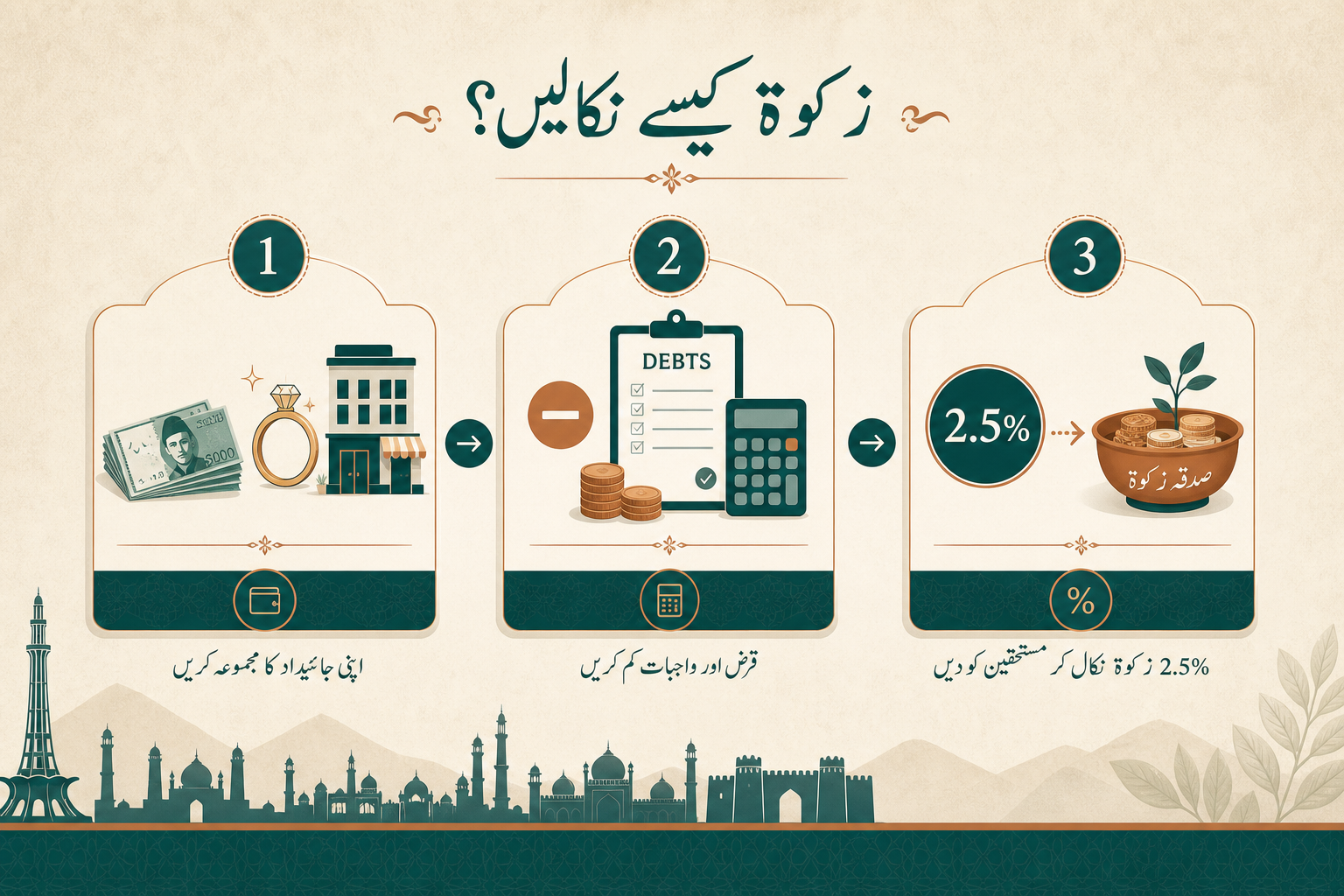
Enter each asset category in PKR. Use market values as of your Zakat calculation date — for gold, multiply grams by the current per-gram price; for shares, use the latest closing value you can reasonably obtain.
Enter debts that reduce your zakatable base, then set the nisab field to today’s gold- or silver-based threshold in rupees. Leave the rate at 2.5% unless you have been advised otherwise for a specific asset type.
Click Calculate Zakat. The result shows total assets, debts, net zakatable wealth, whether you meet nisab, and the Zakat amount due. If you do not meet nisab, the due amount is zero even if you hold some savings.
- List every zakatable asset at market value
- Subtract debts due in the near term
- Compare net wealth with your current PKR nisab
- If above nisab, multiply zakatable wealth by 2.5%
- Give the amount to eligible recipients or a trusted Zakat organisation
The Zakat formula explained
Zakatable wealth = (cash + gold + silver + investments + business goods + receivables + other zakatable assets) − debts due. If zakatable wealth is greater than or equal to nisab, Zakat due = zakatable wealth × 0.025. If zakatable wealth is below nisab, Zakat due = 0.
That is the same structure used by most consumer Zakat worksheets: sum, subtract, test threshold, then apply one-fortieth. The calculator simply does the arithmetic instantly and formats the answer in PKR.
Worked PKR examples
Example one — cash only: You have PKR 800,000 in bank accounts, no gold, no debts, and you set nisab at PKR 250,000 (illustrative silver-style threshold). Zakatable wealth is PKR 800,000, which exceeds nisab. Zakat due = 800,000 × 2.5% = PKR 20,000.
Example two — mixed assets: Cash PKR 400,000, gold jewellery valued at PKR 600,000, mutual funds PKR 300,000, and a credit-card balance of PKR 50,000 due this month. Total assets = PKR 1,300,000. After debt, zakatable wealth = PKR 1,250,000. With nisab at PKR 250,000 you are liable. Zakat due = 1,250,000 × 2.5% = PKR 31,250.
Example three — below nisab: Cash PKR 120,000 and no other zakatable assets, with the same PKR 250,000 nisab. Net wealth is below the threshold, so Zakat due = PKR 0 for this calculation date — though you may still give voluntary charity (sadaqah).
Tips, common mistakes, and giving Zakat in Pakistan
Do not use last year’s gold price for this year’s nisab. Refresh bullion rates and update the nisab field before you finalise. Do not double-count money already moved into a category twice (for example listing the same cash under both “cash” and “other”).
Another frequent mistake is ignoring shop inventory or receivables while only counting the business bank balance — for traders, goods for sale are often a major part of the base. Conversely, do not include the full market value of your family home as if it were surplus trade wealth.
In Pakistan, many people pay Zakat in Ramadan for spiritual reward and convenience, and some banks deduct Zakat from eligible accounts. Keep a simple record of what you calculated and where you paid it. If you also claim Zakat against income tax where rules allow, keep proof for FBR — our Income Tax Calculator guide notes that documented Zakat can matter for tax planning, but tax rules and Zakat rules are not the same system.
When to use related calculators
After you know your Zakat figure, the Percentage Calculator is a quick way to sanity-check 2.5% of any single subtotal. If you are organising annual finances more broadly, the Income Tax Calculator helps estimate salaried tax under current FBR slabs, and the Salary Calculator converts packages into monthly figures for budgeting charity alongside household expenses.
For long-term savings goals after obligatory giving, the Investment Calculator and Inflation Calculator help you see how the remaining portfolio might grow or lose purchasing power over time.