Simple Interest Calculator
Compute interest earned on principal without compounding.
Not every loan or savings product compounds. Simple interest is the version where interest is calculated only on the original principal for the entire period, with no reinvestment of interest earned along the way — the calculation stays linear and transparent from start to finish. This simple interest calculator lets you enter a principal in PKR, an annual interest rate, and a time period in years to instantly see the interest accrued and the total amount due or earned.
Simple interest shows up in short-term notes, some informal lending arrangements between friends or family, certain fixed-tenure products, and countless classroom finance examples, precisely because the math is so easy to verify by hand. This page walks through the formula, worked PKR examples, and the mistakes people most often make when applying it.
On this page
When simple interest applies
Simple interest applies whenever a lender or investment product does not add earned interest back into the balance for future calculations. Each period's interest is calculated fresh, purely on the original amount, regardless of how much interest has already accrued in earlier periods.
This makes simple interest common for short-tenure notes, certain government savings certificates that pay out interest periodically rather than reinvesting it, and informal loans where both parties want an easily verifiable calculation without needing a compounding table.
How to use the simple interest calculator
Enter your principal amount in PKR, the annual interest rate, and the time period in years. If your time period is stated in months, convert it to years first by dividing by 12 (for example, 6 months becomes 0.5 years) before entering it, since the formula expects a yearly figure.
The calculator instantly returns the interest accrued over that period and the total amount — principal plus interest — that will be due or received at the end.
The simple interest formula explained
The formula is I = P x R x T, where I is the interest earned or owed, P is the principal, R is the annual interest rate expressed as a decimal, and T is the time in years. Total amount due at the end of the period is simply P + I.
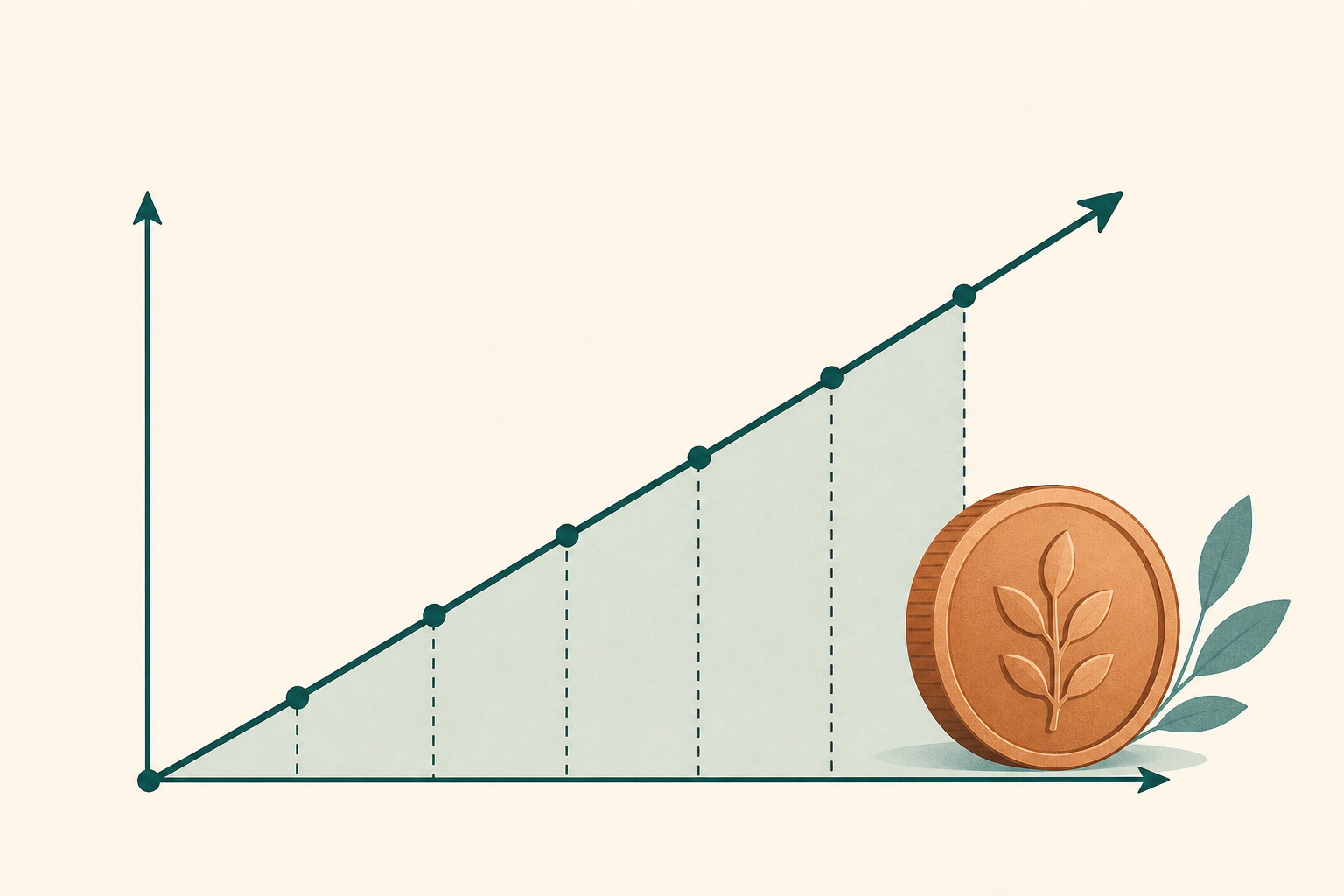
Because the formula is a straight multiplication, simple interest grows in a perfectly straight line over time: doubling the time period at the same rate exactly doubles the rupees of interest, and doubling the rate at the same time period does the same. There is no acceleration effect the way there is with compound interest.
Worked PKR example
Suppose you lend a friend PKR 200,000 at a simple interest rate of 10% per year, to be repaid in full after 2 years. Using the formula, interest equals PKR 200,000 x 0.10 x 2 = PKR 40,000. The total amount due after 2 years is PKR 240,000.
Now compare a shorter, 6-month note of the same PKR 200,000 at the same 10% annual rate. Converting 6 months to 0.5 years, the interest is PKR 200,000 x 0.10 x 0.5 = PKR 10,000, with a total amount due of PKR 210,000 — exactly a quarter of the 2-year figure, because time has scaled down proportionally.
Tips and common mistakes
The most common mistake is forgetting to convert months into a fraction of a year before entering the time value, which can inflate or deflate the result by a factor of 12 if you accidentally enter "6" meaning six months instead of "0.5" for half a year.
Another frequent error is applying simple interest math to a product that actually compounds, such as most bank savings accounts and virtually all EMI-based loans. If your product reinvests interest or charges on a reducing balance, use the Compound Interest Calculator or Loan Calculator instead — using simple interest math there will understate the true cost or return.
Always confirm whether a quoted "annual rate" for a short-tenor note is meant to be applied pro rata for the actual holding period, or whether it is a flat rate regardless of how long the money is actually held — the two conventions produce different answers for anything less than a full year.
When to use related calculators
If your savings or loan product reinvests interest back into the principal each period, the Compound Interest Calculator will give a more accurate picture, especially over multi-year horizons where the gap between the two methods widens. For a general loan repaid in equal monthly installments, the Loan Calculator's EMI-based reducing-balance formula is the correct tool, since almost no consumer installment loan in Pakistan actually uses flat simple interest.
If you simply searched "interest calculator" without a strong preference, the Interest Calculator page uses this same simple-interest engine and can be a faster landing point for quick linear calculations.