Triangle Calculator
Area and basic relations from base and height.
Triangles are the simplest closed shape in geometry, yet they underpin everything from roof-truss design to GPS triangulation and computer graphics. This triangle calculator finds the area of a triangle from a base and height, and explains the alternative Heron’s formula approach when you only know the three side lengths.
A triangle is fully determined once three independent measurements (three sides, two sides and an angle, or two angles and a side) are known, which is why civil engineers and surveyors rely so heavily on triangles for stable, calculable structures.
On this page
The Base-and-Height Formula
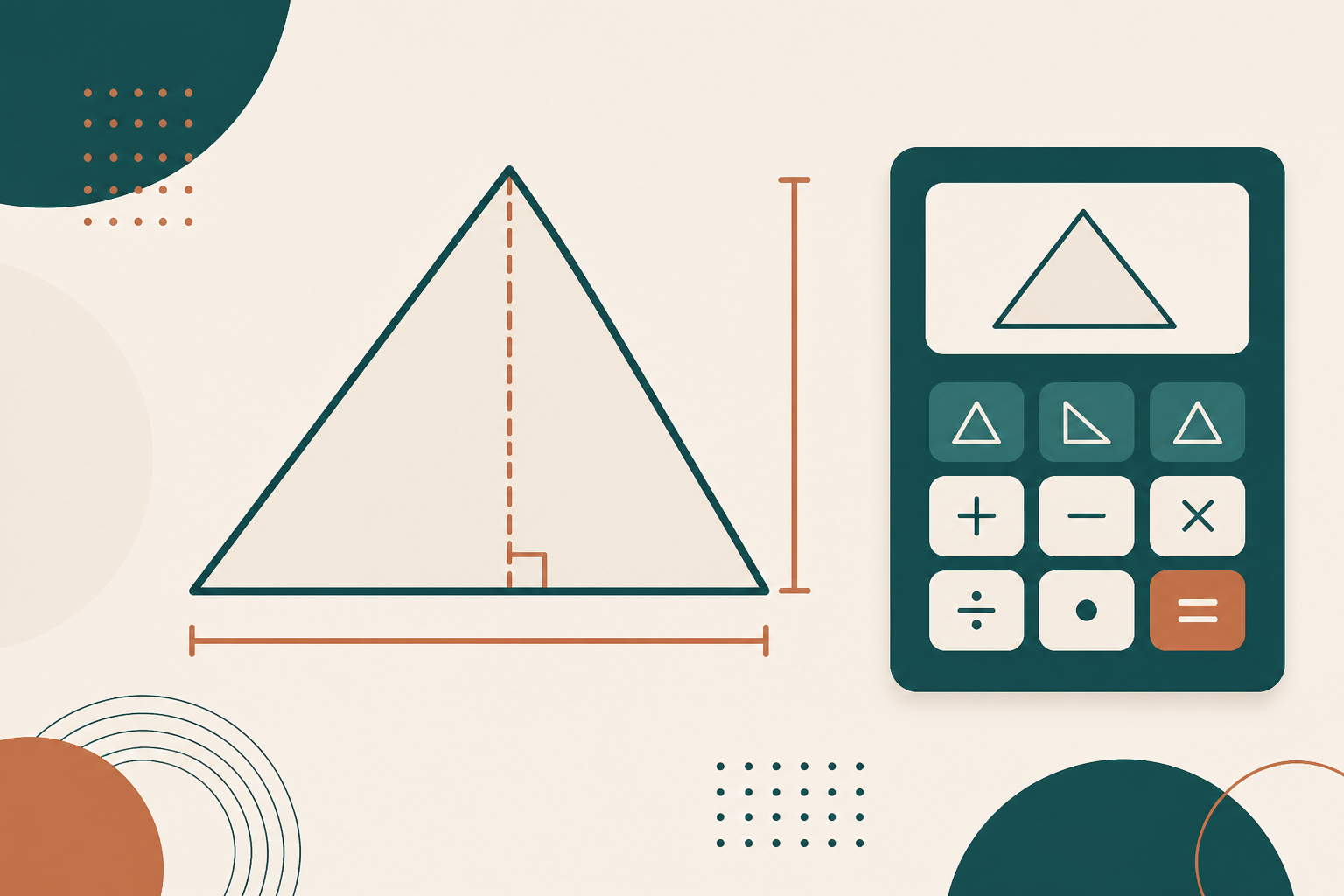
The most common formula is Area = ½ × base × height, where "height" means the perpendicular distance from the base to the opposite vertex, not a slanted side length.
For example, a triangle with a base of 10 cm and a height of 6 cm has an area of ½ × 10 × 6 = 30 cm². If you rotate a copy of the triangle 180° and attach it to the original along one side, you get a parallelogram with area base × height — the triangle is exactly half of that parallelogram, which is where the ½ comes from.
Heron's Formula (Three Sides Only)
When you know only the three side lengths (a, b, c) and not a perpendicular height, Heron’s formula computes area directly. First find the semi-perimeter: s = (a + b + c) ÷ 2. Then Area = √(s(s − a)(s − b)(s − c)).
For example, a triangle with sides 5, 6, and 7 has s = (5 + 6 + 7) ÷ 2 = 9. Area = √(9 × 4 × 3 × 2) = √216 ≈ 14.7 square units. Heron’s formula works for any valid triangle, including ones with no easy right angle to lean on.
Right Triangles and the Pythagorean Theorem
In a right triangle, one leg can serve directly as the base and the other as the height, making area calculation especially simple: Area = ½ × leg₁ × leg₂. The Pythagorean theorem, a² + b² = c² (where c is the hypotenuse, the side opposite the right angle), lets you find a missing side if the other two are known.
For example, a right triangle with legs 3 and 4 has a hypotenuse of √(3² + 4²) = √25 = 5, and an area of ½ × 3 × 4 = 6 square units — the classic "3-4-5" triangle used in construction to check square corners.
Other Useful Triangle Relationships
The interior angles of any triangle always sum to exactly 180°, which is useful for finding a missing angle once two others are known. When two sides and the angle between them are known, the formula Area = ½ × a × b × sin(C) finds area without needing a separate height measurement.
- Angle sum rule: A + B + C = 180° for any triangle.
- Two sides and included angle: Area = ½ × a × b × sin(C).
- Law of cosines (find a missing side): c² = a² + b² − 2ab·cos(C).
- Law of sines (relate sides and opposite angles): a/sin(A) = b/sin(B) = c/sin(C).
Triangles in Real-World Design
Triangles are the only polygon shape that cannot be deformed without changing the length of at least one side, which is exactly why roof trusses, bridge supports, and bicycle frames rely so heavily on triangular bracing for structural rigidity — a rectangle can rack into a parallelogram under load, but a properly built triangle physically cannot.
Surveyors have used the same principle for centuries in triangulation: measuring the angles and one side of a triangle formed between known landmarks lets them calculate distances to a new point without physically measuring the full distance, a technique still foundational to modern GPS positioning and mapmaking.
When a problem needs sine, cosine, or the law of cosines rather than a simple base-and-height area, the Scientific Calculator is the natural next step for evaluating those trigonometric expressions.